(511) 326 1175
Corrugated Board Guide
CORRUGATED
BOARD FEATURES
Corrugated board packaging is a package formed by the junction of papers by means of an adhesive, which form and presentation adapts to the product being packaged, ensuring that it reaches its destination in optimal conditions. Each package must be designed to withstand the physical demands due to handling, transportation, storage conditions, vibrations, shocks, weather conditions, humidity, fatigue, deformation, etc. Corrugated boards manufactured in ICYP are made from papers, adhesives (corn starch) and water-based flexographic inks. All raw materials are certified for food contact and are 100% recyclable. This guide highlights practical recommendations and key criteria for the proper handling, assembling, filling, stowage and palletizing of corrugated packaging. It also provides guidance on the shipping, distribution and transportation conditions to which the packages are exposed throughout the logistics chain.
Types of corrugated board
This material is widely used due to its composition. It combines layers of linerboard and corrugated medium to provide strength and durability to the structure, while different combinations of liners and corrugated medium allows the board to achieve specific performance characteristics.
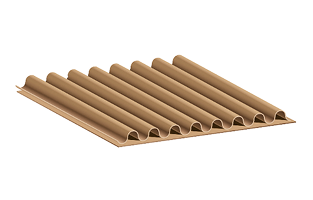
Single face
This board grade is manufactured with one liner and one corrugated medium, for a total of two paper layers. This allows the packaging of small objects that could be damaged during transportation, due to its lightness and impact resistance.
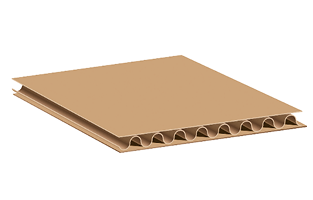
Single corrugated
This board grade is manufactured with two liners and one corrugated corrugated medium, for a total of three layers. This cardboard is frequently used in boxes for logistics and packaging.
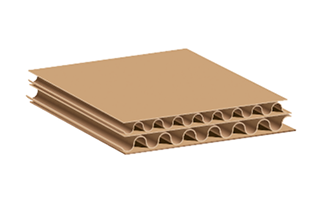
Double corrugated
This board grade is manufactured with three liners and two corrugated medium, for a total of five layers. The result is a more durable box that can be used for heavy items packaging.
Depending on the flute profile of the corrugated board
Corrugated boards can also be classified according to its thickness, which depends on the flute height of the corrugated medium. The most typical thicknesses are the following:
Flute F= 1,3 – 1,5 mm, “microcorrugated”.

Flute C = 3,8 – 4,2 mm, “medium flute”.

Flute E = 1,6 – 1,8 mm, “microcorrugated”.

Flute EB = 4,7 – 4,9 mm, “double flute”.

Flute B = 2,6 – 2,8 mm, “small flute”.

Flute EB = 4,7 – 4,9 mm, “double flute”.

BENEFITS OF CORRUGATED BOARD FOR PACKAGING
This is the most widely used packaging material in logistics due to its many advantages, which are summarized below:
Light Material: The geometric design of the corrugated flutes provides high stacking strength while requiring a relatively low amount of raw material.
Flexible Material: In addition, corrugated board grades with fewer layers are highly flexible, allowing them to conform closely to the shape of the product and provide effective protection during transportation.
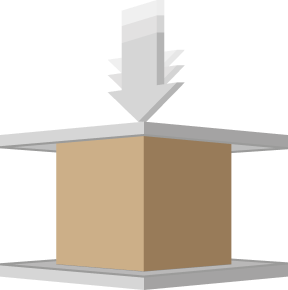
Durable Material: This board grade supports a load up to 2000 Kg depending on its geometric design.
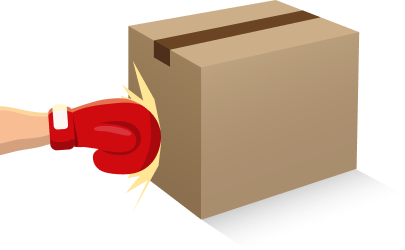
Good absorbtion of vibrations, shocks and impacts:
Due to being a flexible material and with plenty of air in its inside, corrugated board is very useful as a shock absorber. Therefore, it is capable of absorbing both vibrations and shocks and impacts, in this way protecting your packaged items. It is ideal for protecting fragile items.
Suitable for all modes of transportation:
Another advantage of corrugated board is its great versatility and can be manufactured in different dimension to meet various needs. This makes it suitable to be transported by any mode of transportation such as airplanes, ships, trains or trucks, since boxes are quiet easy to handle and to organize. In addition, their high compression strength allows them to be stacked safely, maximizing storage space and improving logistics efficiency.
Versatile and very beneficial material:
In conclusion, it is not surprising that corrugated board is so highly valued in the logistics industry. In addition, corrugated board is increasingly being used for premium packaging, as well as for furniture manufacturing, exhibition stands and decorative items.
Respect for the environment:
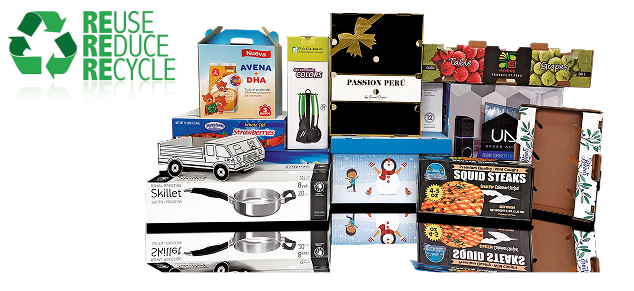
Corrugated board is a 100% recyclable product made from renewable resources. This makes it an environmentally friendly packaging material.
Graphics can be printed on the outer surface of corrugated board:
The possibility of printing product identification, logos, and other corporate branding elements directly on corrugated packaging is highly valued by the business sector.