(511) 326 1175
Corrugated Board Guide
CORRUGATED BOARD PACKAGE
ASSEMBLING, FILLING AND SEALING GUIDE
Corrugated board is a material with ample possibilities of use in its conversion to packaging for the most diverse goods. Its structural strength and flexibility to adapt to different measures, automated packaging system, and transport conditions, has turned it into a product with widespread market distributiion. A corrugated board package confronts very high exigencies (packaging, storage and distribution). The steps enclosed in its process inevitably generate wear and tear, the same that must be contemplated during the designing and manufacturing phases.
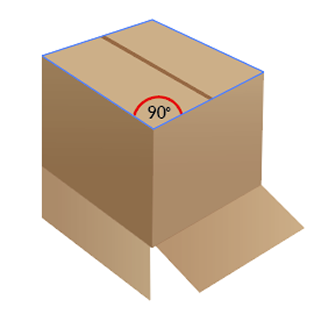
1. Open the folded boxes and form the bottom without forcing the corners or creasing the box panels.
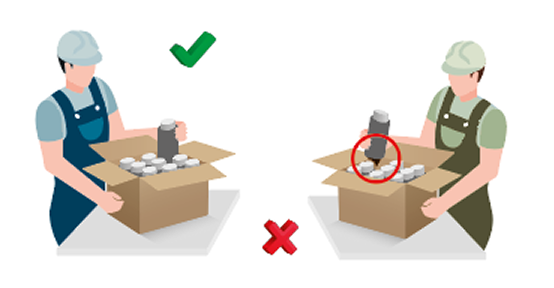
2. Introduce the goods neatly, without pushing or folding outwards the lateral box panels, or ripping its corners.
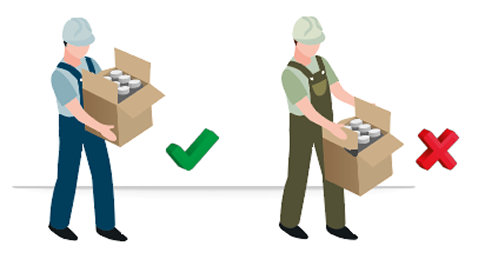
3. If it is necessary to move boxes containig goods before they are sealed, always support them from the bottom. Never lift or carry them by the top flaps.
Why? When lifting the box by its flaps, it is very probable that the flaps and the corners of the box may tear and collapse.
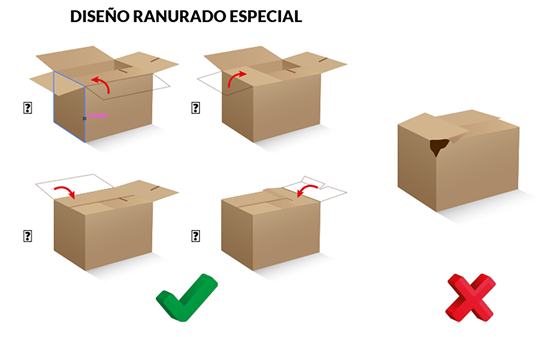
4. When temporarily closing the boxes, do not interlock or jam their flaps. Demand and use the special slotting design for your boxes, which allows them to be closed without damage.
Why? During flap interlocking or jamming, high torsional stresses are generated at the corners of the box, causing them to crack.
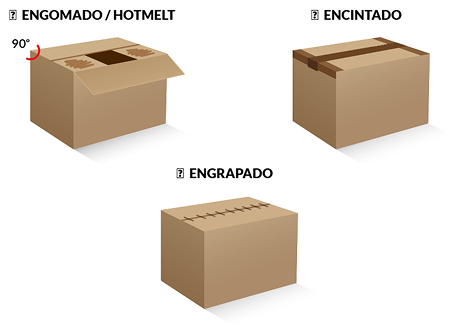
5. In order to close or seal the box flaps, use gummed or hot-melt adhesive whenever possible.
Why? Hot-melt adhesive has been the most proven type of sealing and with optimal results. Gummed tape stands in second place and stapling in third place.
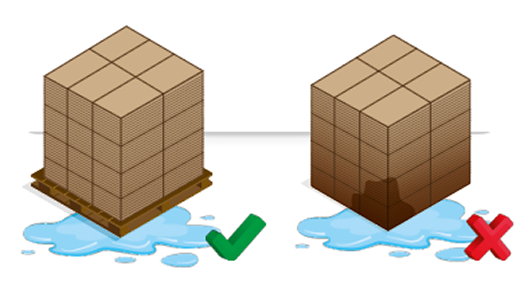
6. Stack the boxes on wooden or plastic pallets, keeping them off the ground.
Why: The ground is the main source of moisture. At night, as the temperature drops, the humidity in the air condenses, forming dew on the ground. Furthermore, accidental water spills will affect the strength of the boxes.
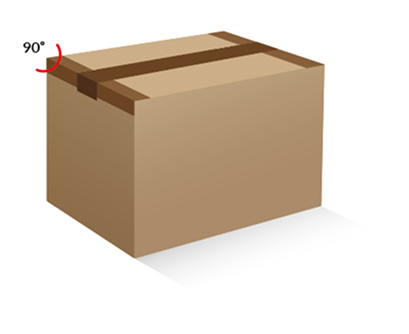
7. If using tape, apply it along both the width and length of the joints between the major flaps to provide a secure seal and protect the contents from dust.
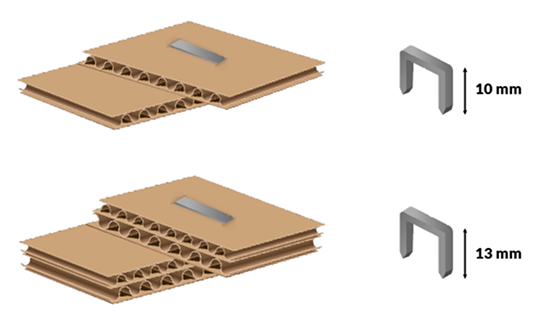
8. Staples especifications for Single-Wall and Double-Wall cardboards.
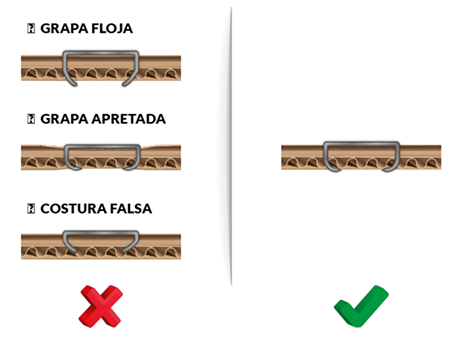
9. Boxes stapling.
Why? The staples legs must fully pass through the parts to be joined and be bent over; the inner cardboard of the box should be slightly compressed.
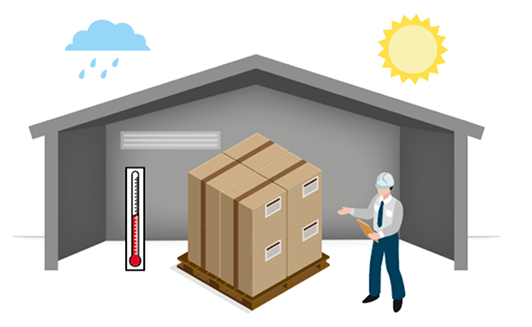
10. Store the boxes in covered warehouses, in a dry, well-ventilated environment.
Why? Moisture is one of the factors that mostly affect the strength and duration of the boxes when stacked. In a moist environment (70% to 90% relative humidity) a box loses between 60 to 80% of its original strength.
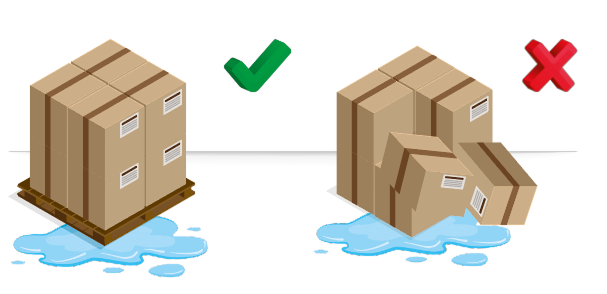
11. Stack the boxes on wooden or plastic platforms, pallets or on surfaces raised above the floor to protect them from moisture, liquid spills and dirt.
Why? If the bottom layer of the palletized load fails due to excessive moisture, stack stability will be lost, resulting in a dangerous and costly collapse of the boxes and their contents.
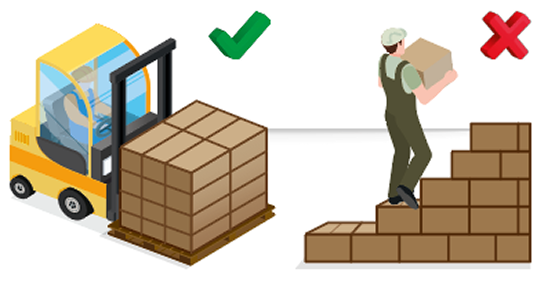
12. Use forklift equipment or stepladders on wooden or plastic pallets if you are going to stack loads beyond your normal reach height; do not use the boxes as steps.
Why? Stepping on the boxes not only damages the packaging but also the product.
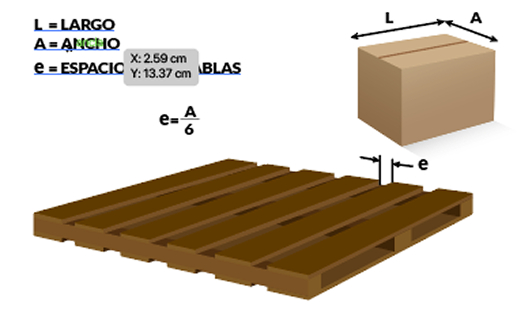
13. Wooden or plastic pallets used for multi-level vertical stacking should be reversible, and the spacing between deck boards should not exceed one-sixth of the width of the box.
Why? If one of the edges of the boxes placed on the bottom layer is not fully supported on the pallet’s surface, the load may become unstable because stack resistance decreases considerably.
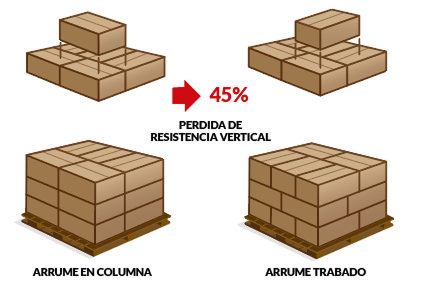
14. During stacking it is best if the boxes should be vertically aligned so that their four corners coincide.
Why? The greatest vertical strength of the boxes is concentrated in the corners.
If they are stacked in columns making corners to coincide, the full benefits of this property (Strength) will be achieved. If the boxes become jammed, their stacking strength may be reduced up to 45%.
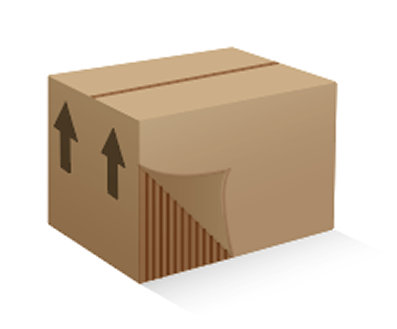
15. Place the boxes according to the pictograms and with the corrugation running vertically.
Why? During stacking, when placing the boxes the instructions on them must be followed to ensure optimal performance.
16. During stacking, it is best if the boxes are aligned vertically with their four corners coinciding.
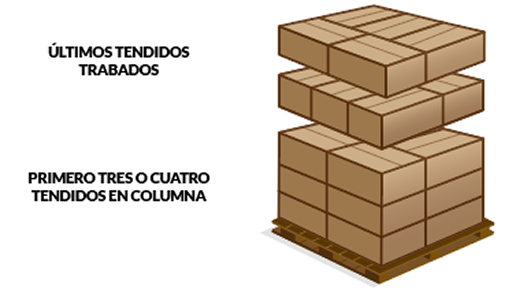
Why? Stack the first three or four layes in columns, aligning the corners of the boxes vertically. To complete the stowage, interlock the top one or two layers to improve stability.
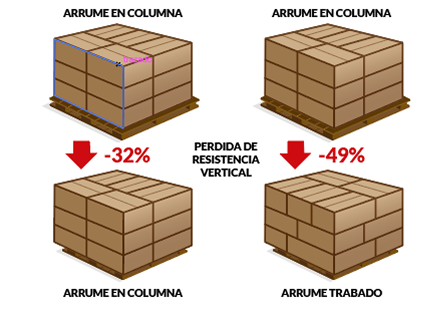
17. When building the stacking pattern over a wooden or plastic platform, the edges of the boxes must not extend beyond the pallets edges, as this may cause some boxes to overhang.
Why? Laboratory tests comparing stacks with identical characteristics showed that, when the outer boxes overhang the pallet by 2.5 cm, the vertical compression strength of a columned-stack load is reduced by 32%. But if the stack is interlocked and the boxes overhang the pallet by the same amount, the vertical compression strength decreases by 49%.
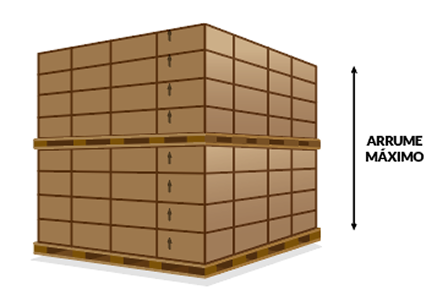
18. Boxes stacking should be done with its corrugation direction in vertical position and should not excede the maximum height determined for its structural design.
Why? Structurally boxes cannot support an infinite weight above them. These are designed according to the characteristics of their contents, storage conditions and warehouse capacity, among other requirements. As a result, each box has a stacking strength limit that must be respected.